

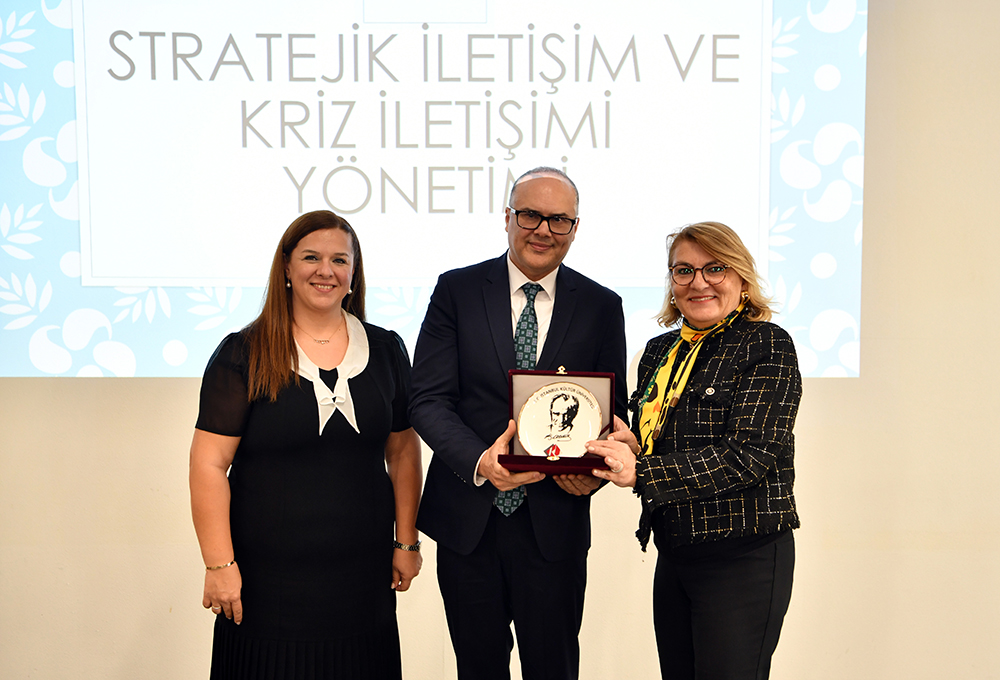
Assoc. Prof. Dr. Bora Bayraktar, a journalist and faculty member of our International Relations Department, was this month's guest at the traditional leadership and vision meetings held at the Design Factory in the Ataköy building of the Bakırköy Campus. Assoc. Prof. Dr. Bayraktar answered questions on the topic of Strategic Management and Crisis Communication Management.
In her opening speech before the seminar, our Rector, Prof. Dr. Fadime Üney Yüksektepe stated, “Educational management, by its very nature, is a field intertwined with multiple generations. Our work is a multifaceted area. We value effective communication with young people, researchers, scientists and thinkers, stakeholders from the business world and civil society organizations. Furthermore, we are in an era that necessitates awareness in risk and crisis management. In this regard, the seminar by our esteemed professor from the Department of Political Science and International Relations, Assoc. Prof. Dr. Bora Bayraktar, has been a very valuable guide for us.”
Assoc. Prof. Bora Bayraktar: “Strategic communication is not a promotional activity, it is a form of governance”
Speaking at a seminar on Strategic Communication and Crisis Communication Management, Assoc. Prof. Dr. Bora Bayraktar emphasized that communication today has moved beyond being limited to message transmission and has transformed into a governance tool. Assoc. Prof. Dr. Bayraktar defined strategic communication as “a process carried out in a planned, measurable, and coordinated manner in line with predetermined goals”, while underlining that this approach should not be confused with advertising, press releases, or statements made during a crisis. Our professor stated, “For an institution to make a press release after a crisis is communication; anticipating the crisis and creating appropriate discourse sets is strategic communication.” Drawing attention to the fact that strategic communication is located at the intersection of strategy, communication, and management disciplines today, Assoc. Prof. Dr. Bayraktar stated that speed, consistency, and narrative continuity are among the key determinants. “Good strategic communication does not manage crises; it prevents crises from becoming destructive”, said Assoc. Prof. Dr. Bayraktar, and stated that this approach offers an indispensable framework for institutions and public administration.
Strategic Mistake: Giving the Same Message to Everyone
Associate Professor Dr. Bayraktar, who also touched upon the practical dimension of strategic communication, summarized the importance of the target audience in the process with the following words: “Giving the same message to different stakeholders such as students, families, academics, the public, and decision-makers is a strategic mistake. Messages for different target audiences should not contradict each other. Consistency and timing are important in the narrative. When the right message is given at the wrong time, it can deepen the crisis.”
Crisis is Inevitable Without Risk Communication
During the seminar, Assoc. Prof. Bayraktar highlighted the key differences between risk and crisis communication. Emphasizing that risk is a pre-event, manageable stage, Bayraktar noted that crisis communication begins exactly where risk communication fails. He stated that the goal of risk communication is not merely to persuade the public, but to prepare the organization for potential threats, noting that scenario-based planning and communication guidelines play a critical role at this stage. Highlighting that the most common mistakes during a crisis are prolonged silence, contradictory statements, and a defensive tone, Dr. Bayraktar emphasized that communication can never serve as a substitute for concrete action.